
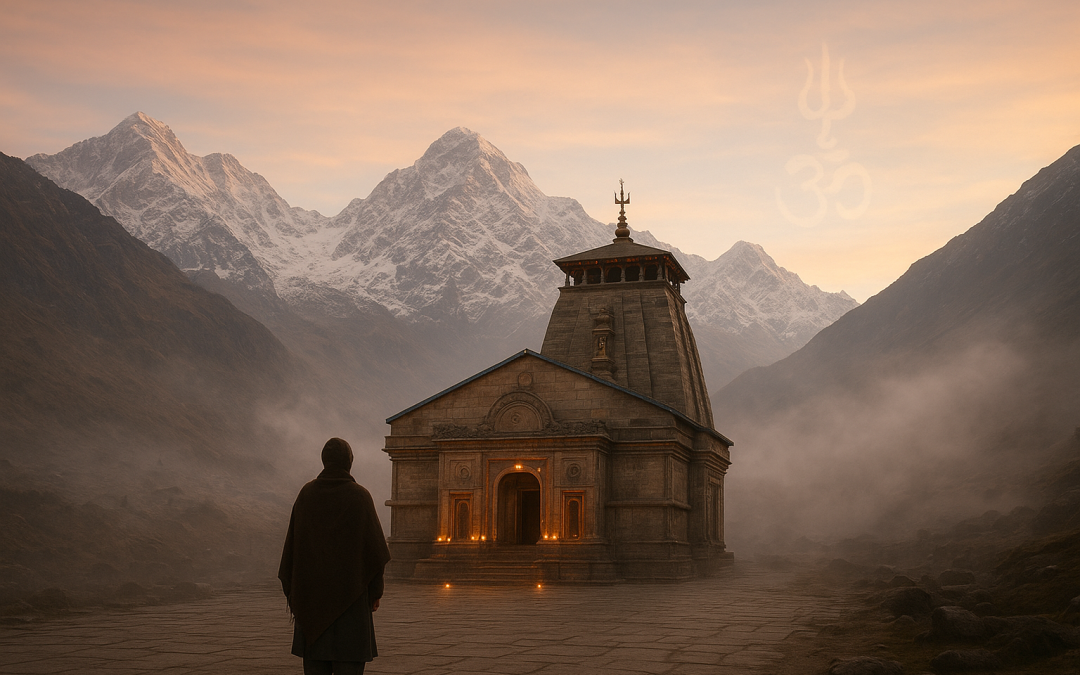
Why We Travel to Kedarnath When Shiva Lives at Home
My grandmother wakes at 5 AM daily to worship the Shiva lingam in our puja room. She’s done this for sixty years.
Yet at 78, she insisted on making the treacherous journey to Kedarnath – 3,583 meters high, accessible only by a 16km trek. When I asked why, she smiled: “Beta, we can light a lamp at home. But some lamps burn differently at the source.”
That answer haunted me. If God is everywhere, why travel hundreds of kilometers to one temple?
The scriptures says “The concept is ‘Tirtha’ – crossing place,” explains Dr. Bharati Mukhopadhyay, Sanskrit professor at Calcutta University. “Places where the veil between mundane and divine is thinner. Think of it like electricity – you can have a small generator at home, or tap into a power plant. Both work, but the intensity differs.”
The geography: I traveled to Kedarnath last summer. The journey is brutal – thin air, burning lungs, dizziness.
Geologist Dr. Ranjan Sharma showed me survey maps: “Kedarnath sits at unusual geological features. High magnetic fields, underground streams, crystalline rocks producing piezoelectric effects. The ancients couldn’t measure this scientifically, but they felt something.”
Dr. Ananya Ghosh, psychologist at Presidency University: “Sacred spaces gain power from millions pouring devotion over thousands of years. When you enter where countless people have prayed and transformed, your brain responds differently. You’re primed for transcendence.”
Priests say: Mahant Chandragiri in Varanasi: “Home worship is your daily discipline. Pilgrimage is transformation. When you trek to Kedarnath tired and breathless, your prayers become honest. You’re not going through motions – you’re genuinely reaching out.”
After months of research, I shared everything with my grandmother.
She laughed. “At home, I speak to Shiva about my arthritis, your marriage, the neighbor’s noise. It’s intimate, comfortable.”
“But at Kedarnath, I stood before Him as a speck. Mountains towering, cold wind cutting, absolute silence. I didn’t ask for anything. I just stood. Felt small. And somehow, felt complete.”
Maybe it’s geological. Maybe psychological. Maybe divine.
Or maybe the difference isn’t in the place – it’s in us. We need both. The everyday intimacy of home worship AND the transformative shock of pilgrimage.
The lamp at home lights your way. The lamp at Kedarnath reminds you of the sun.